






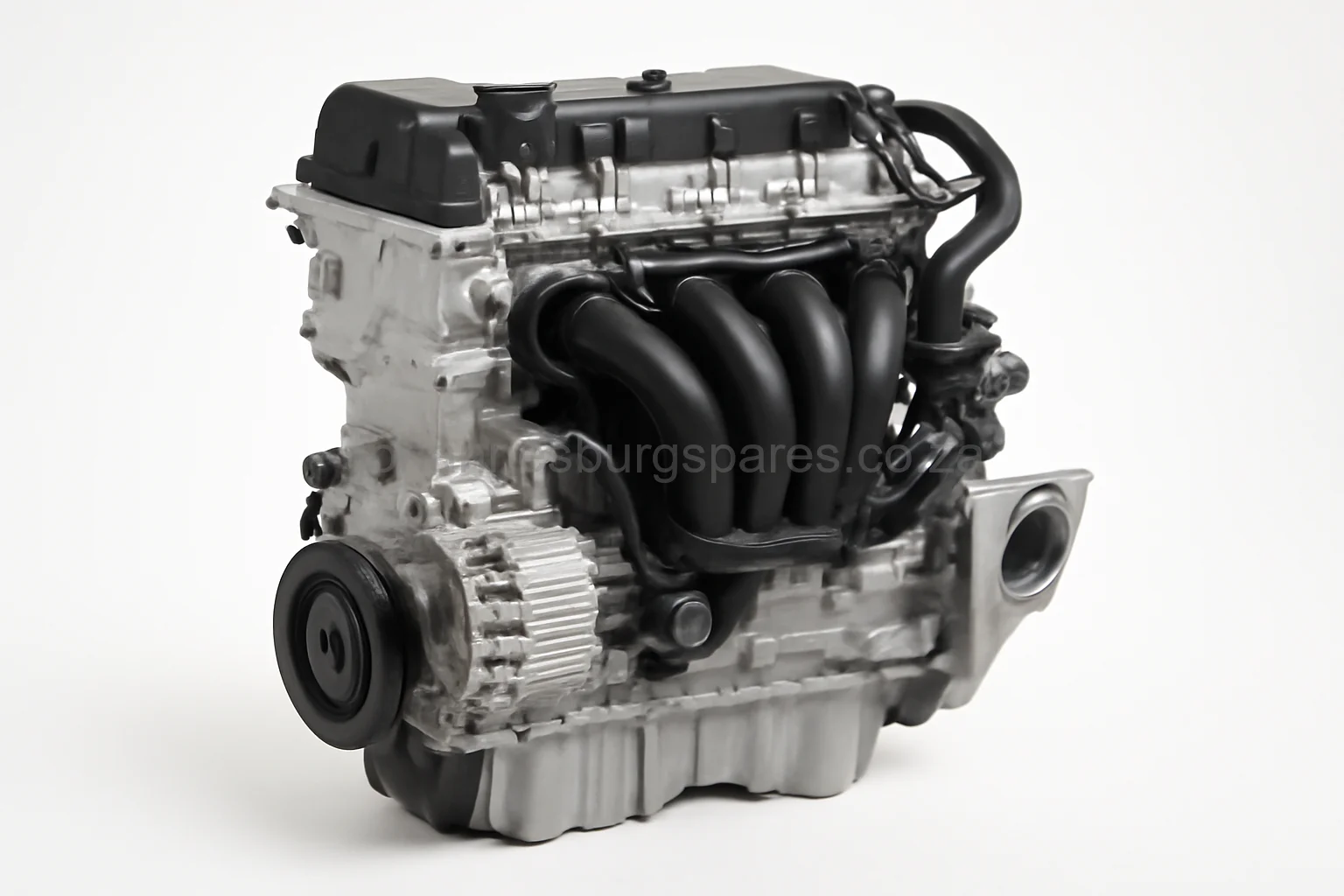
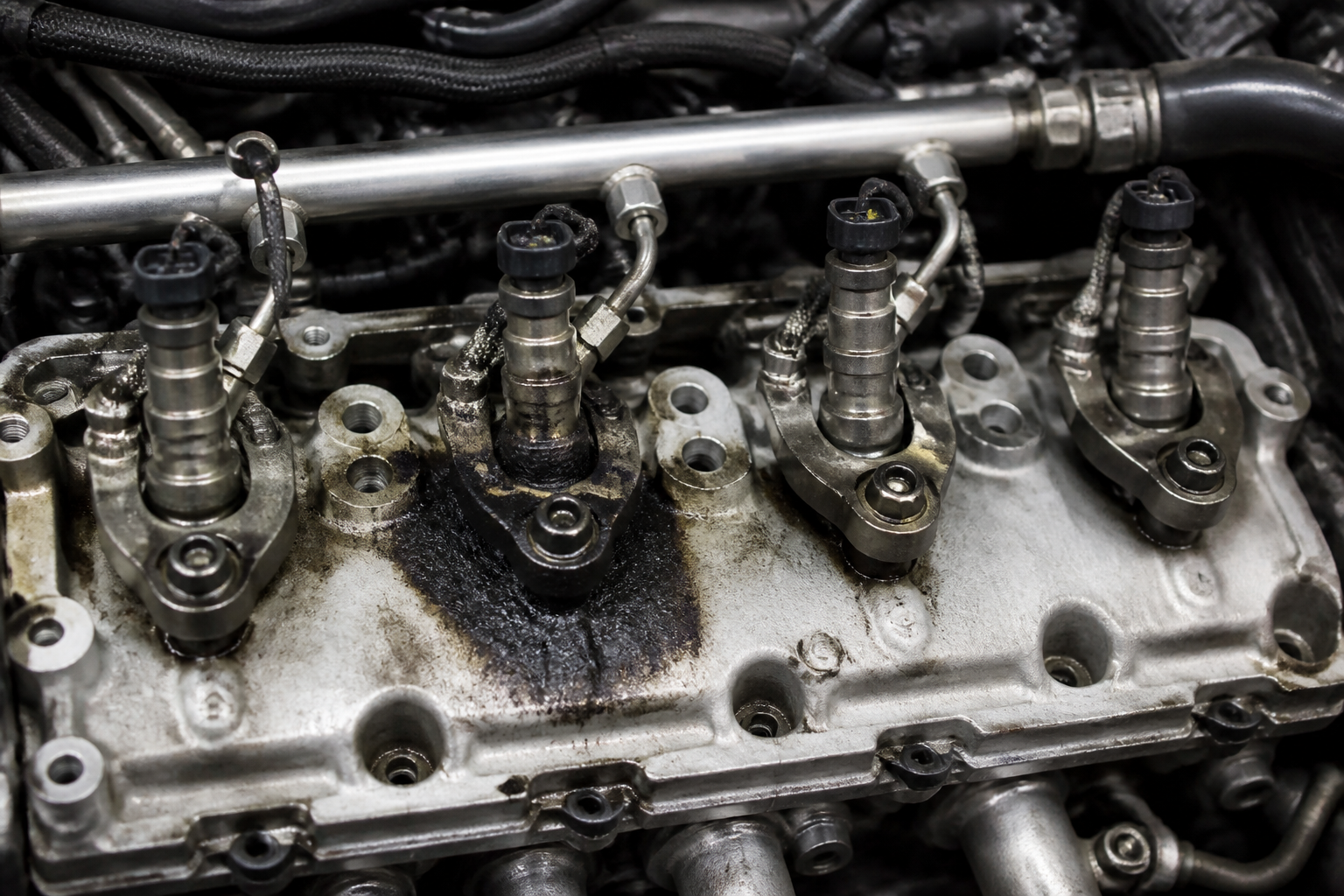

If you own a 2.2 CDI Mercedes and you have started hearing a soft, rhythmic chuff-chuff-chuff from the top of the engine at idle - or you catch a whiff of diesel exhaust inside the cabin on a cold morning - stop reading the forums about turbos and take the plastic engine cover off. On the OM646 four-cylinder diesel, those two symptoms together almost always mean one thing: an injector sealing washer has failed, and the engine is quietly baking a crust of carbon into the cylinder head around it. Owners call it black death, and the reason it matters is not the cost of the seal. It is what the seal costs you if you leave it.
| The short version | What it means for you |
|---|---|
| The part that fails is a copper washer | A soft copper ring, crushed flat under the injector to seal combustion pressure. It is one of the cheapest items on the engine. |
| The early warning is noise and smell | A rhythmic chuffing or puffing at idle, and diesel fumes in the cabin, usually before anything is visible. |
| You will not find it with a scanner | None of the workshop sources below attach a fault code to a leaking injector seal. It is found by eye, ear and nose. |
| Waiting is what makes it expensive | The carbon deposit grows and progressively cements the injector into its bore. |
| Worst case is a cylinder head | A truly seized injector can be destroyed coming out, and on very high-mileage engines the head itself can be the casualty. |
| Affected models | C200/C220 CDI, E200/E220 CDI, CLK220 CDI, CLC200/220 CDI, Vito and the 2006-2009 Sprinter. |
What the OM646 is, and which Mercedes have it
The OM646 is Mercedes’ 2,148 cc four-cylinder common-rail turbo-diesel, built from 2002 to 2010. It succeeded the OM611 and was itself replaced by the OM651. Almost everyone calls it the 2.2 CDI, because that is how Mercedes badged it - when CAR Magazine road-tested the facelifted C220 CDI here in South Africa in March 2005, they described it as a “2,2-litre, four-cylinder turbodiesel” making 110 kW at 4 200 r/min and 340 N.m at 2 000 r/min. The extra 52 cc never made it onto the bootlid.
It went into a lot of cars that are still on South African roads today:
| Model | Chassis | Years |
|---|---|---|
| E200 / E220 CDI | W211 E-Class | 2002-2009 |
| C200 / C220 CDI | W203 C-Class | 2003-2007 |
| C200 / C220 CDI | W204 C-Class, pre-facelift | 2007-2009 |
| CLK220 CDI | C209 | 2005-2010 |
| CLC200 / CLC220 CDI | CL203 | 2008-2010 |
| Vito | W639 | 2003-2010 |
| Sprinter 209-516 CDI | W906 | 2006-2009 |
Those year ranges matter more than they look, and we come back to them at the end - because a C220 CDI can be an OM646 or an OM651 depending on which side of 2009 it falls, and the two engines do not share injectors.
Why one small washer brings the whole thing down
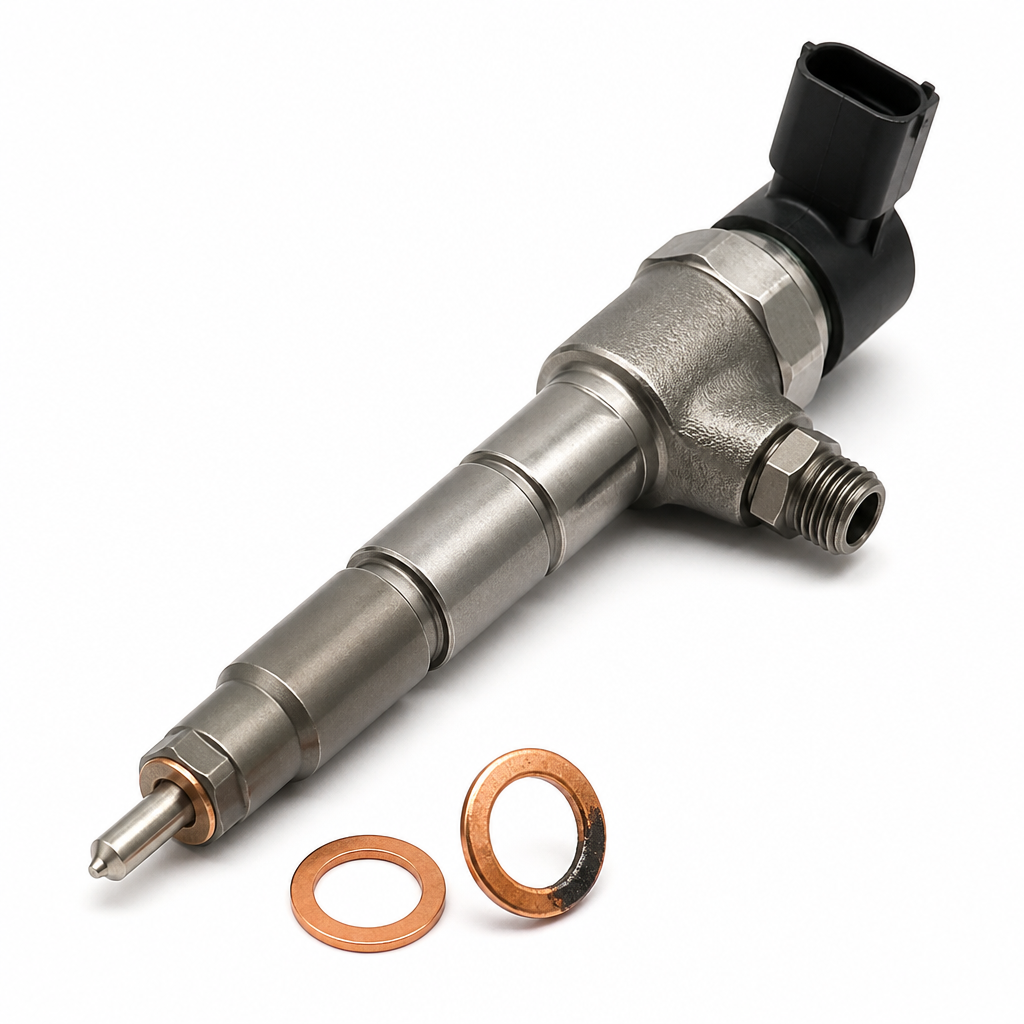
Here is the bit that surprises people: the injectors are not screwed into the head. As the Mercedes-Benz StarTuned technical bulletin puts it, “the injectors are not screwed in to the bores but rather clamped in under pressure which puts a crush on the copper seal.” A clamp and bolt press each injector down onto a soft copper washer, and that crushed washer is the only thing standing between the combustion chamber and the outside world. The injectors “seat directly in the combustion chamber,” so the seals have “a critical task of keeping the combustion gasses contained within the chamber.”
The sealing works by deformation rather than by tightness. A workshop guide to injector copper washers describes it precisely: “clamp load crushes the soft copper into the microscopic irregularities of seat and injector nose, forming a gas-tight joint against combustion pressure.” That is also why a used washer must never go back in - “a used washer has work-hardened into its set shape and cannot conform again, which is why reuse is the number-one washer sin.” The same guide names the Mercedes OM646 CDI among the engines where this commonly bites.
Once that seal is compromised, the failure feeds itself. The guide calls it the black-death spiral: “Failure lets combustion gas leak past on every firing stroke: hot gas carbonises fuel and oil residue around the injector body, the deposit grows, sealing worsens, and the injector is progressively cemented into its well.” Every kilometre you drive makes the next repair a little harder. StarTuned is blunter about the moment of no return: “once the combustion seal is compromised there’s no going back.”
The symptoms, in the order you will meet them
The fault announces itself long before anything looks wrong, which is the good news - if you know what you are listening for.
- A rhythmic chuffing or puffing at idle. High-pressure gas escaping past the washer once per firing stroke. Owners on the UK forums describe it as “a chuffing noise and an odd smell”. It is loudest with the bonnet up and the engine cold.
- Diesel fumes inside the cabin. Very often the first thing anyone actually notices - one owner’s account has “smelling fumes inside the car” as sign number one, before any visible deposit.
- Black crust around the injector base. Only visible once the plastic engine cover comes off. It starts as “thick gooey (when hot) sludge around the affected injector” and hardens into a dry black ring baked onto the aluminium.
- Rough running or a cold-start stumble. Later, and not always present. Plenty of OM646s leak for a long time while still driving perfectly well.
That order - noise first, mess second - is exactly how owners describe it. Writing to a UK Mercedes specialist in 2017, the owner of a 2004 Vito 115 CDI panel van - a W639, so an OM646 - put the whole arc into two short sentences: “It started chuffing and resulted in black death. My number one injector started leaking.”
One thing worth saying plainly: this is not a fault you diagnose with a scan tool. None of the workshop sources used for this guide attaches a specific fault code to a leaking injector seal. A quick practical check used in the trade is to wet the area while the engine runs - as one MBClub thread puts it, put “water or solvent on the rocker cover when the engine is running. You should see the leak easily.”
Heard The Chuffing? Get OM646 Injector Parts.
We supply injectors and the seals and fixings that go with them for the OM646 2.2 CDI — quality used and aftermarket, matched to your C-Class, E-Class, Vito or Sprinter chassis and delivered nationwide.
Why a cheap washer turns into an expensive job
Caught early, this is close to the cheapest repair on the engine: the washers cost very little, and the labour is pulling the cover, releasing the injector clamps, lifting the injectors out, cleaning the seats back to clean metal and putting it all back together with new seals and bolts.
The cost lives entirely in how hard the injector is to get out. That is a function of how long the leak has been left, and it is not linear - the carbon does not simply sit there, it keeps welding the injector to its bore.
When one is properly stuck, the trade reaches for progressively more aggressive tools, and each step carries its own risk:
- A slide hammer on a nut welded to the injector body. Usually enough.
- A dedicated puller. StarTuned warns that “a major drawback to these is they leverage against the valve cover which is fairly thin aluminum and can crack” - so a botched extraction can add a cover to the bill.
- A specialist extraction tool. On the worst ones this is the only option left, and it is a one-way trip. An MBClub workshop contributor: “we have had a few where no slide hammer in the world will remove the injector, in this case the special klann removal tool is best but it does render the injector useless.” The injector does not survive the removal.
- The head comes off. StarTuned’s assessment of the far end of the scale: “A vehicle with 200k plus with really stuck injectors may warrant a new head.” At that point you are shopping for cylinder heads over a washer that would have cost almost nothing if it had been caught while the noise was still new.
There is one more risk that has nothing to do with force. With the injector out, the bore is full of hard carbon sitting directly above an open cylinder. The standing instruction in the trade is to “make sure you vacuum at every stage to avoid the carbon entering the cylinder or bolt hole” - because debris dropped into the cylinder is a far worse day than the leak ever was. The seats must also be cleaned back to clean metal before the new washer goes in, or the fresh seal simply fails again.
So the honest summary of the cost is this: the parts are cheap and predictable, and the labour is anything from an hour to a cylinder head, decided entirely by how long the noise was ignored. That is why we will not put a single rand figure on this job sight-unseen - the same fault on two identical cars can be two completely different bills. Send us the model, year and VIN and we will price the actual diesel injectors and seals your engine needs, rather than a guess. If yours has already gone the distance, we also carry used and reconditioned engines for the 2.2 CDI range.
OM646 or OM651? Check the year before you buy anything
This is where owners and parts buyers get caught, and it is worth thirty seconds of your time.
The badge on the boot does not tell you which engine is in the car. A C220 CDI built in 2008 is an OM646; one built in 2010 is an OM651. Same badge, same shape, different injectors, different seals. The Sprinter changed over in the same period, and the Vito ran the OM646 until 2010.
Both engines suffer injector-related problems, but they are not the same problems and the parts do not interchange - if your C-Class is a 2010 or later build, our guide to OM651 engine problems is the one you want instead. If you are unsure which you have, the VIN settles it, and we will check it for you before anything is quoted or shipped.
Not Sure Which Engine You Have? Send Us The VIN.
We will confirm whether your 2.2 CDI is an OM646 or an OM651 before you spend a cent, then quote the correct injectors, seals and cylinder head parts for your exact build.
Frequently asked questions
Can I just keep driving with a leaking injector seal? You can, and many people do for a long time, because the car usually still drives normally. But the deposit grows the whole time and steadily welds the injector into the head, so every month of driving makes the eventual repair harder and more expensive. This is the rare fault where the cost genuinely goes up while you wait.
Do I have to replace the injector, or just the seal? If the injector comes out cleanly and tests fine, it goes back in with a new copper washer, a new hold-down bolt and a cleaned seat. The injector itself only gets replaced when it is damaged during removal or has failed on test.
Can I reuse the old copper washer? No. The washer seals by being crushed out of shape, and once crushed it has work-hardened and cannot conform again. The workshop rule is to “replace the washer every single time an injector is disturbed - no exceptions, no inspections, no judgement calls.”
Will it throw a warning light? Not reliably, and none of the technical sources behind this guide ties a specific fault code to a leaking injector seal. Treat the chuffing noise and the diesel smell as the warning light.
My mechanic says the injector is seized - what now? Then it becomes a question of which tool and how much collateral damage is acceptable. Specialist extraction tools will get almost any injector out but usually destroy it in the process, so budget for a replacement injector as well as the seals, and ask the workshop up front what happens if the seat is damaged.